A new Dragonfly pond will be excavated & the original Dragonfly pond filled in as it has a very invasive plant species in it (Crassula)
Welcome
to our Wetlands, a Yorkshire Wildlife Trust Reserve of regional importance for
birds, run by the Trust in partnership with our dedicated team of local
volunteers and developed in partnership with Humberside Aggregates (H. Agg)
Seating arena
The new seating area is now open, and gives good views of the Village Lake & the feeding station
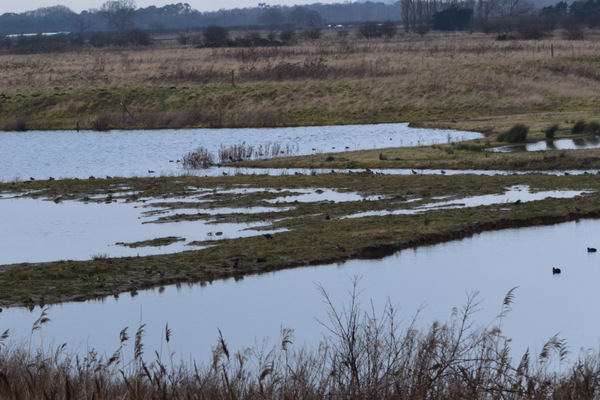
Scene from the new viewing point
North Cave Wetlands would like to thank Johnson & Jeff for their kind sponsorship of the reserve feeding stations

Work parties
Regular work days have started on the reserve and everyone is more than welcome, they are held on the 2nd and 4th Thursday of every month. Please contact Tony Martin 07825668420 if interested
We have recently identified two highly invasive plant species within the Dragonfly ponds, these are Australian Swamp Stonecrop (Crassula helmsii) and Parrots feather (Myriophyllum aquaticum). Both of these species are non-native and extremely invasive, the plants grow around the margins of ponds and in water up to 3m deep. Crassula helmsii forms very dense stands, it appears as a small tussock and then spreads rapidly to form a dense mat of vegetation. This mat then out-competes all other aquatic vegetation, eliminates native flora and creates a poorer ecosystem for invertebrates. Severe oxygen depletion can then occur. The plant assimilates CO2 for 20 hours of the day when submerged due to the possession of crassulacean acid metabolism and grows throughout the year, there is no dormant period.
Control and eradication of these plants is very difficult and the first priority is to contain them to avoid further infestations and encroachment into surrounding water bodies. We have used chemical control to eradicate the plant but with minimal success.
As you can see we have netted the pond to ensure the plant cannot be transported to other water bodies and an eradication programme is underway with guidance from Natural England.
History
The
40 ha. original Reserve to the north of Dryham Lane includes some 20 ha. of
water, following extraction of sand and gravel by H. Agg over the 20 years
leading up to acquisition of the site by the Trust in 2000.
We
inherited 6 deep and bare holes. Over the next 3½ years H. Agg made a wonderful
job of moving some 250,000 tonnes of material into, out of, or around the site
to our specification, with considerable design assistance from Roger Mitchell
of Potteric Carr. The 10m deep Reedbed Lake was infilled with
inert material to make a shallow lake with islands and reedbeds. The 1½
ha. Island Lake was made into a 3 ha. shallow lake with numerous islands.
The water level in Village Lake was reduced to expose gravel beds. All
the lakes were connected underground with a gravity driven water level
management system and with the overflow taken into Black Dyke to the north.
We now submerge shallow gravel islands in the winter with rain ground and
spring water, to limit vegetation. We expose them in the spring for
passage and breeding waders and ducks.
The
infrastructure was completed with 3 large hides (2 with disabled access),
paths, rafts, interpretation boards, seats, screens and bird tables. The
perimeter path and hides were positioned to give optimum viewing for
serious birders, novice naturalists and photographers alike. The
eastern boundary was planted up with winter berry-bearing bushes to create a
visual and noise screen from the main road and to add habitat.
Wader scrapes and small dragonfly ponds extended site biodiversity.
Dryham Lane was surfaced, a car park created, and from 2008 Angela Brown’s Wild
Bird Cafe has been dispensing hospitality 7 days a week.
In
2004 H. Agg bought 42 ha. of farmland to the south of Dryham Lane and to the west
of our original boundary, and asked us to partner them in a planning
application for a Phase 2 development. Planning approval was subsequently
granted to “extend North Cave Wetlands by the extraction of 3.4 million tonnes
of sand and gravel”. Quarrying of the 17 ha. Dryham Ings started in 2008
and was completed in 2011. By 2013 restoration work had been largely
finished, creating three flat interlinked cells of flood meadowland to the
design of Phil Fermor of Middlemarch Environmental. YWT staff specified
the splendid 60 sq.m. Crosslands Hide, built of timber frame with straw bale
infill, to overlook the new meadowland to the east, H. Agg’s silt pond and
future extensions to the west.
The
Future – the Western Extension
By
2013 the original Reserve plus Dryham Ings and the silt pond extended to some
60 ha. The remaining 20 ha. of Phase 2 will be excavated and
restored up to 2016 as deep water lakes; this is the area of deepest
aggregate deposit. But expansion won’t stop there, for in 2008 we
partnered H. Agg in a successful planning application again to quarry a further
57 ha. of farmland to the south and west of Phase 2. The aggregate
deposits to the west are shallower, enabling H. Agg to restore this land for us
to a mixture of shallow water, more flood meadowland and reedbeds over the next
12 years.
.jpg)
